
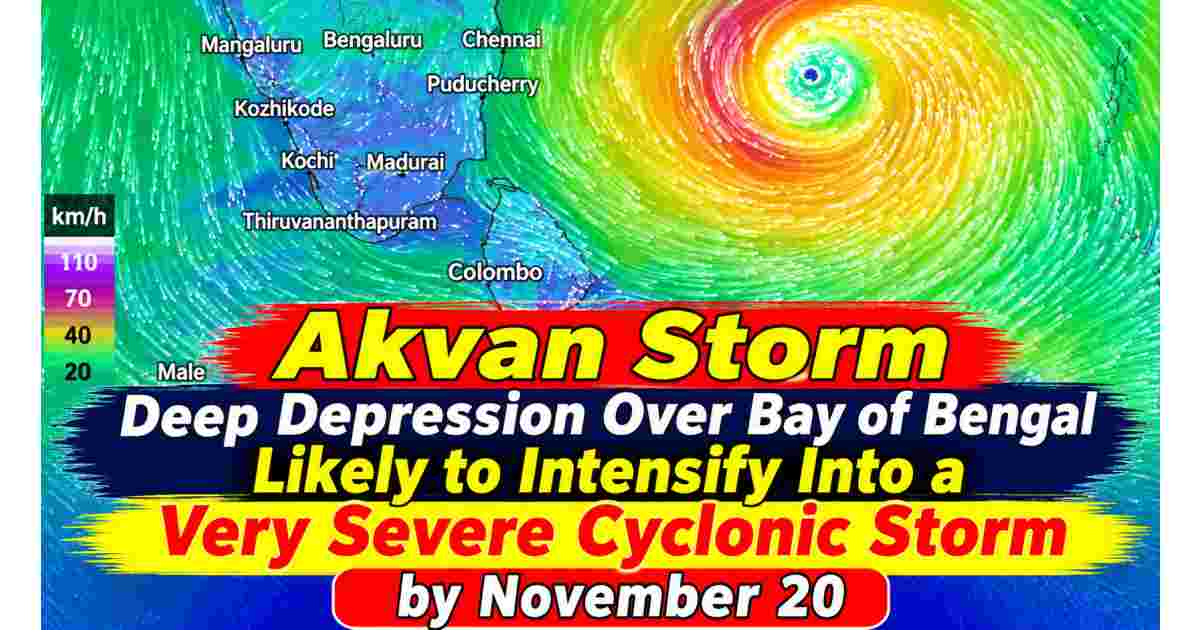
A deep depression over the Southeast and adjoining Southwest Bay of Bengal is expected to intensify further over the coming days, potentially developing into a Very Severe Cyclonic Storm before approaching the Andhra Pradesh coast of India on November 20, 2026.
According to the latest weather bulletin issued on November 16, the system was moving north-northwestwards at approximately 6 km/h. Its centre was located near 11.2°N latitude and 86.4°E longitude, approximately 630 km northeast of Trincomalee, Sri Lanka.
The system is forecast to continue moving north-northwestwards while gradually strengthening. It is likely to become a Cyclonic Storm over the central parts of the south and adjoining west-central Bay of Bengal by the evening of November 16. Further intensification into a Severe Cyclonic Storm is expected around November 17.
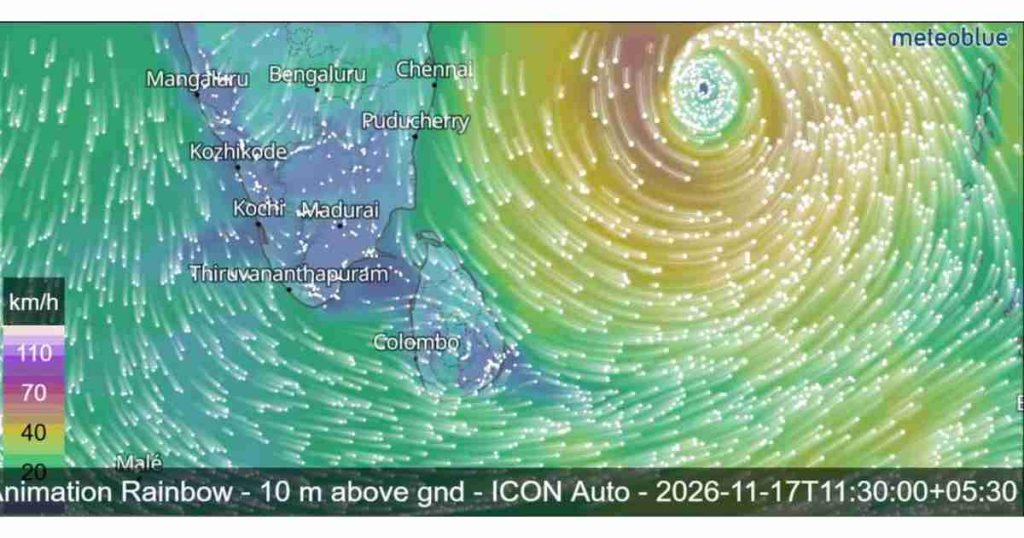
The cyclone is then expected to intensify further while moving west-northwestwards. According to the forecast, it could become a Very Severe Cyclonic Storm by November 19.
Expected Landfall and Wind Speeds
The latest forecast indicates that the system is likely to cross the Andhra Pradesh and Yanam coasts of India between Nellore and Tuni by approximately 11:30 a.m. Sri Lanka time on November 20.
At the time of landfall, maximum sustained wind speeds are forecast to reach 120–130 km/h, with gusts reaching up to 145 km/h. These powerful winds could bring dangerous weather conditions to coastal areas.
Forecast Uncertainty
Meteorological models generally indicate further intensification and north-northwestward movement. However, some differences remain among forecast models regarding the exact landfall location and timing. The bulletin gives moderate to high confidence in the forecast track and moderate to high confidence in the predicted intensity.
The Madden-Julian Oscillation (MJO), equatorial Rossby waves and Kelvin waves are also identified as atmospheric factors supporting enhanced convective activity over the Bay of Bengal during November 16–21.

What About Sri Lanka?
At the time of the bulletin, the system was located approximately 630 km east-northeast of Trincomalee. Its continued movement towards the Indian coastline will be important to monitor. People in Sri Lanka should follow updates and official weather advisories issued by the Department of Meteorology.
The forecast track and intensity may change as the system develops. Therefore, the next updates from meteorological authorities will be important.