
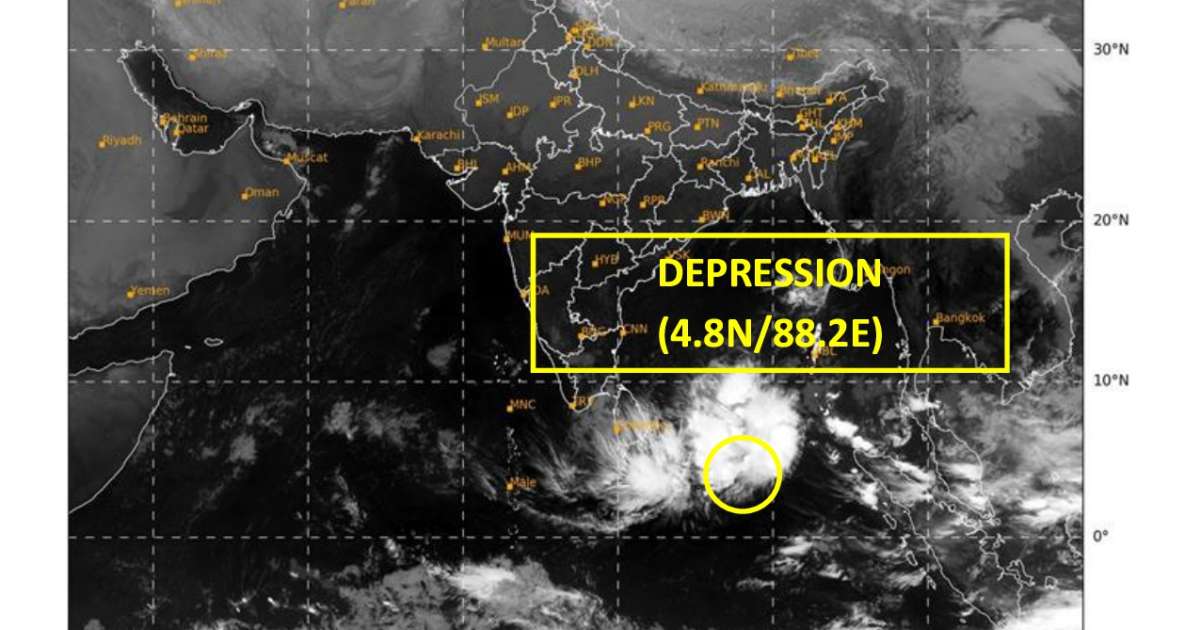
A depression has developed over the southeast Bay of Bengal and the adjoining East Equatorial Indian Ocean, marking a significant intensification of the weather system that had previously existed as a well-marked low-pressure area. According to the latest meteorological observations, the system concentrated into a depression at around 03:00 UTC on 7 January 2026 and remains centred over the same region near latitude 4.8°N and longitude 88.2°E. At the time of observation, the system was located approximately 740 kilometres east-southeast of Pottuvil, about 790 kilometres east-southeast of Batticaloa, 880 kilometres east-southeast of Trincomalee, and farther southeast of the Indian coastline including Karaikal and Chennai.

Meteorological agencies indicate that the depression is likely to intensify further into a deep depression within the next 24 hours. The system is expected to move initially in a west-northwestward direction towards the southwest Bay of Bengal during the next 48 hours. The estimated central pressure of the system is around 1008 hectopascals, with maximum sustained wind speeds reaching about 25 knots. Sea conditions in the vicinity of the system remain rough, with significant wave heights of approximately 4.0 metres. Observations from a nearby buoy at 6.5°N and 88.3°E reported a mean sea-level pressure of 1010.7hPa and sustained winds of around 70°/ 26 kt

Satellite imagery from INSAT-3DS indicates that the system currently has an intensity of T1.5. The associated cloud pattern shows scattered to broken low- and mid-level clouds with embedded areas of intense to very intense convection over the southern Bay of Bengal and the adjoining Equatorial Indian Ocean. Minimum cloud-top temperatures have dropped to around minus 90°, indicating strong convective activity.

Atmospheric and oceanic conditions remain generally favourable for further development. Guidance from the ECMWF model suggests that the Madden–Julian Oscillation is presently in phase six with a weak amplitude and is likely to remain in the same phase over the next five days. Sea surface temperatures over the Equatorial Indian Ocean and southern Bay of Bengal are around 29°, gradually decreasing to about 27° closer to the Sri Lankan coast. Model guidance also indicates supportive wind anomalies and equatorial wave activity, which are likely to enhance convective processes associated with the system until around 8 January.
Upper- and lower-level atmospheric analyses show increased convergence and divergence patterns that are favourable for maintaining the system’s intensity. Wind shear remains moderate and anti-cyclonic over the system area, while warm air advection continues to support deep convection. Numerical weather prediction models show good agreement regarding the west-northwestward movement of the system across the southwest Bay of Bengal during the next three days. Some models suggest further intensification into a deep depression on 8 January, followed by gradual weakening thereafter, with a possible approach towards the eastern coast of Sri Lanka around 9 January.