

Rainy Season, Monsoons, Temperature and the Best Time to Visit
Sri Lanka is known for its tropical climate, warm beaches, green mountains and landscapes shaped by seasonal rainfall. However, the weather is not the same across the entire island. While Colombo and the southern coast can experience heavy rain, parts of the eastern coast may enjoy sunshine. In the Central Highlands, temperatures can be much lower than in the surrounding lowlands.
Understanding Sri Lanka’s weather is useful for residents, travellers, farmers and anyone planning outdoor activities. The island experiences two main monsoon seasons and two inter-monsoon periods, each influencing different regions at different times of the year.
According to the Department of Census and Statistics, Sri Lanka receives an average of approximately 2,000 millimetres of rainfall annually, although the amount varies considerably by location. Some areas receive far more rain than others, while parts of the dry zone experience comparatively long periods with little rainfall.
So, when is the rainy season in Sri Lanka? Which month is the coldest? Where does the highest rainfall occur? And when is the best time to visit? Here is a closer look at the country’s climate and the questions people frequently ask about Sri Lanka’s weather.
Understanding Sri Lanka’s Weather and Climate
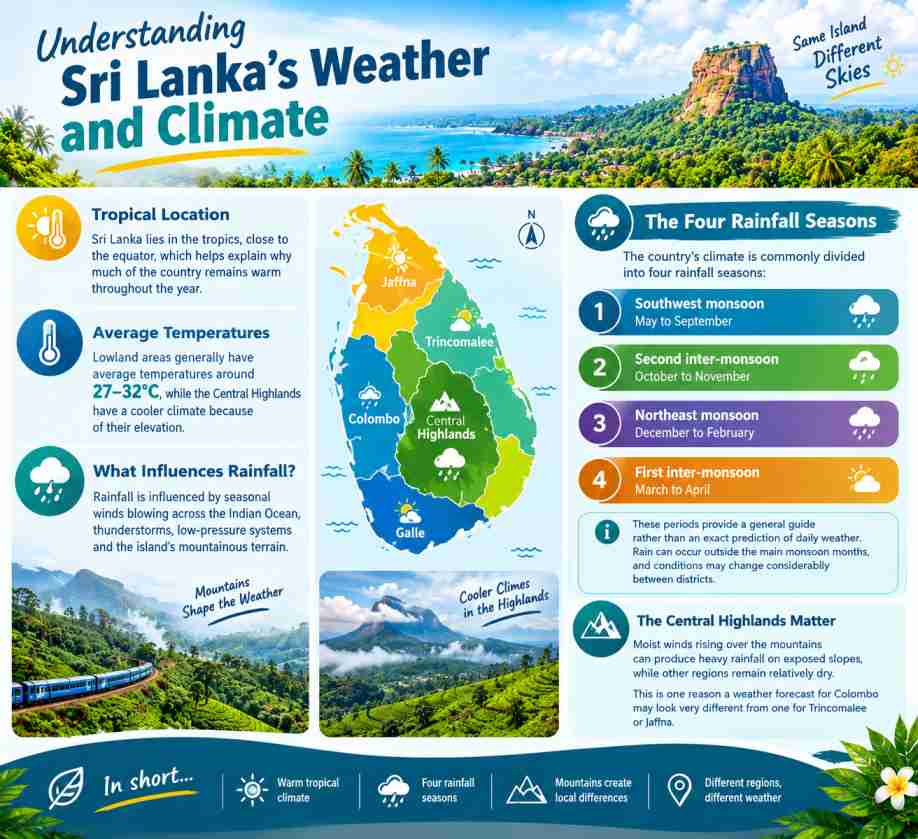
Sri Lanka lies in the tropics, close to the equator, which helps explain why much of the country remains warm throughout the year. Lowland areas generally have average temperatures around 27–32°C, while the Central Highlands have a cooler climate because of their elevation.
Rainfall is influenced by seasonal winds blowing across the Indian Ocean, thunderstorms, low-pressure systems and the island’s mountainous terrain.
The country’s climate is commonly divided into four rainfall seasons:
- Southwest monsoon: May to September.
- Second inter-monsoon: October to November.
- Northeast monsoon: December to February.
- First inter-monsoon: March to April.
These periods provide a general guide rather than an exact prediction of daily weather. Rain can occur outside the main monsoon months, and conditions may change considerably between districts.
The Central Highlands also play an important role. Moist winds rising over the mountains can produce heavy rainfall on exposed slopes, while other regions remain relatively dry. This is one reason a weather forecast for Colombo may look very different from one for Trincomalee or Jaffna.
Sri Lanka Weather FAQs
01. Is It Rainy Season Now in Sri Lanka?
Late October falls within Sri Lanka’s second inter-monsoon season, which generally runs from October through November.
During this period, showers and thunderstorms can develop across many parts of the island. Rainfall may occur during the afternoon or evening, although the timing varies depending on local weather conditions.
Western, Southern, Sabaragamuwa and Central areas can experience unsettled weather, while northern and eastern districts may also receive rain. Low-pressure systems over the Bay of Bengal can contribute to changing conditions and periods of heavier rainfall.
However, being in the rainy season does not mean that rain falls continuously throughout the day. Some locations may experience short, intense showers followed by sunshine, while other areas receive more prolonged rainfall.
If you are planning to travel or work outdoors in October and November, check the latest local forecast rather than relying only on the seasonal outlook. During periods of heavy rain, pay attention to official warnings about flooding, landslides, lightning and strong winds.
02. What Are the Main Monsoon Seasons in Sri Lanka?
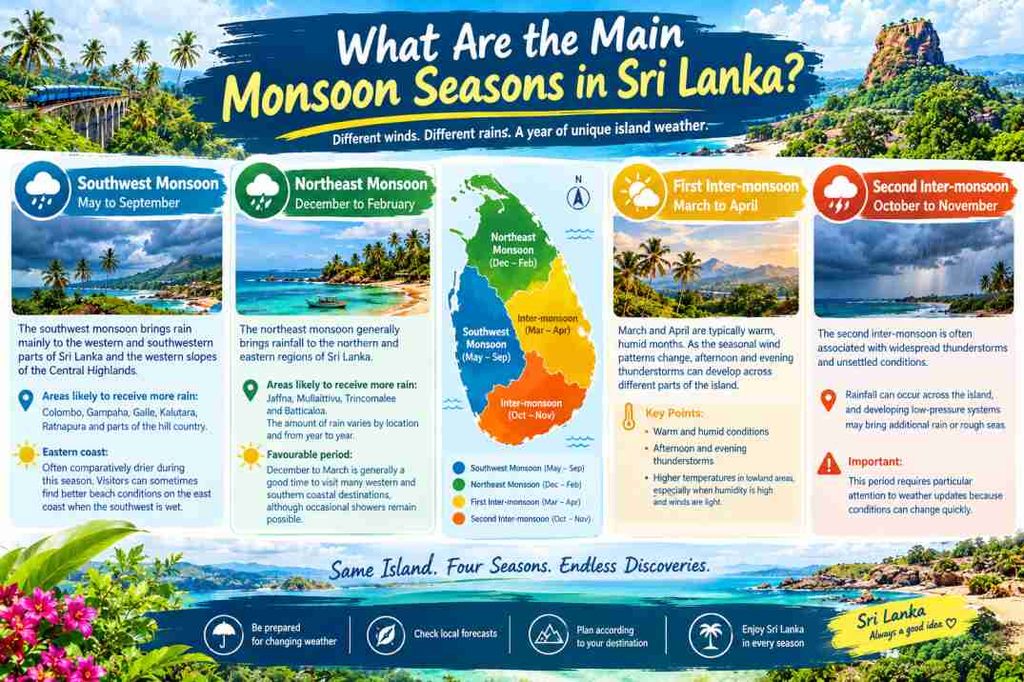
Southwest monsoon: May to September
The southwest monsoon brings rain mainly to the western and southwestern parts of Sri Lanka and the western slopes of the Central Highlands.
Colombo, Gampaha, Galle, Kalutara, Ratnapura and parts of the hill country can experience periods of substantial rainfall during this season.
The eastern coast, including areas around Trincomalee and Batticaloa, is often comparatively drier during the same months. This regional difference means that visitors can sometimes find more suitable beach conditions on the east coast when the southwest is wet.
Northeast monsoon: December to February
The northeast monsoon generally brings rainfall to the northern and eastern regions of Sri Lanka.
Jaffna, Mullaittivu, Trincomalee and Batticaloa can experience increased rainfall during this period. The amount of rain varies by location and from year to year.
Meanwhile, December to March is generally a favourable period for visiting many western and southern coastal destinations, although occasional showers remain possible.
First inter-monsoon: March to April
March and April are typically warm, humid months. As the seasonal wind patterns change, afternoon and evening thunderstorms can develop across different parts of the island.
Temperatures may feel particularly high in lowland areas, especially when humidity is elevated and winds are light.
Second inter-monsoon: October to November
The second inter-monsoon is often associated with widespread thunderstorms and unsettled conditions.
Rainfall can occur across the island, and developing low-pressure systems may bring additional rain or rough seas. This period requires particular attention to weather updates because conditions can change quickly.
For the general seasonal pattern, see the Sri Lanka Department of Census and Statistics climate information.
03. What Is the Best Month to Visit Sri Lanka?
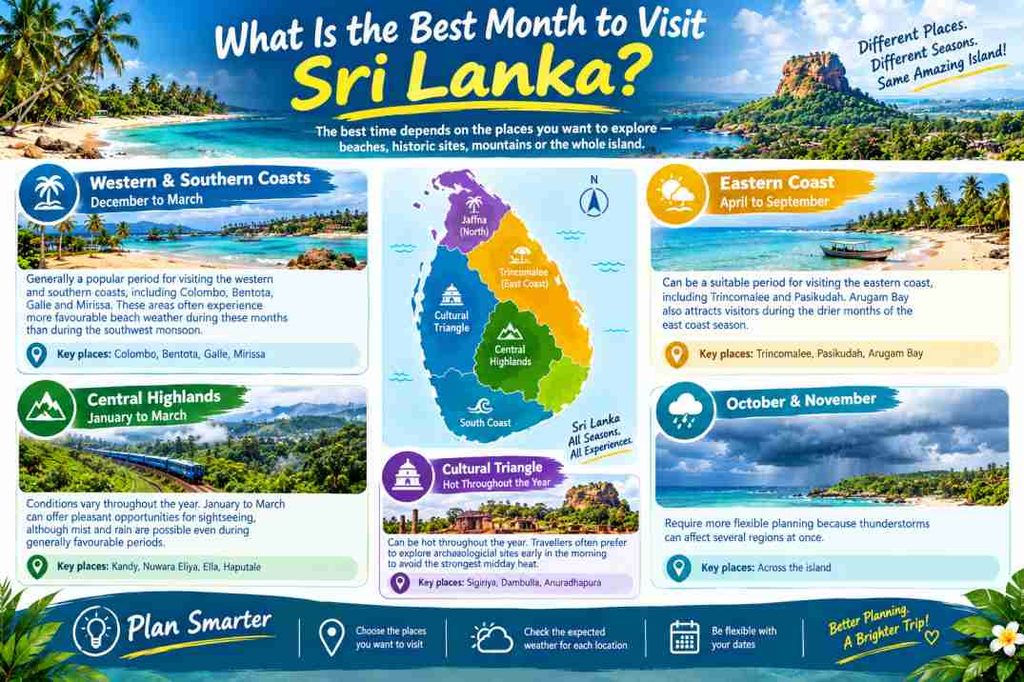
There is no single best month for every destination in Sri Lanka. The right time depends on whether you want to explore beaches, visit historic sites, walk through the mountains or travel around the country.
December to March is generally a popular period for visiting the western and southern coasts, including Colombo, Bentota, Galle and Mirissa. These areas often experience more favourable beach weather during these months than during the southwest monsoon.
April to September can be a suitable period for visiting the eastern coast, including Trincomalee and Pasikudah. Arugam Bay also attracts visitors during the drier months of the east coast season.
For the Central Highlands, conditions vary throughout the year. January to March can offer pleasant opportunities for sightseeing, although mist and rain are possible even during generally favourable periods.
The Cultural Triangle, including Sigiriya, Dambulla and Anuradhapura, can be hot throughout the year. Travellers often prefer to explore archaeological sites early in the morning to avoid the strongest midday heat.
October and November require more flexible planning because thunderstorms can affect several regions at once.
Rather than choosing a month based on the whole country, decide which places you want to visit and then check their expected weather conditions.
04. What Is the Coldest Month in Sri Lanka?
January is generally one of the coolest months in Sri Lanka, particularly in the Central Highlands.
Nuwara Eliya experiences much cooler conditions than the coastal lowlands. According to climatological information published by the Department of Census and Statistics, the town’s average minimum temperature is around 9.4°C in January.
The coastal areas remain considerably warmer. Even during the coolest months, places such as Colombo generally experience tropical temperatures rather than winter conditions.
The difference is largely explained by elevation. As air rises over higher terrain, temperatures generally decrease. This makes the mountainous interior much cooler than the surrounding plains.
Visitors travelling to Nuwara Eliya, Horton Plains or other high-elevation locations may find warm daytime clothing and an additional layer useful, particularly during early mornings and evenings.
05. Which Is the Coldest City in Sri Lanka?
Nuwara Eliya is widely known as one of Sri Lanka’s coldest towns and is often described as the country’s coldest major town.
Located high in the Central Highlands, it has a climate that differs considerably from that of Colombo, Jaffna and other lowland cities. Temperatures can fall to around 9–10°C on typical cool-season nights, with colder conditions possible on some occasions.
The area is also known for its tea plantations, misty landscapes, gardens and surrounding mountains.
However, the place recording the lowest temperature on a particular day may vary with weather conditions and measurement locations. Nuwara Eliya’s reputation reflects its generally cool highland climate rather than a guarantee that it records the lowest temperature every day.
06. What Is the Coolest Area in Sri Lanka?
The Central Highlands contain some of the coolest locations in Sri Lanka.
Nuwara Eliya is among the best-known examples, but the wider highland region includes other elevated areas where temperatures are lower than in the lowlands.
Horton Plains, the higher slopes around the Nuwara Eliya region and parts of the mountain ranges can experience cool mornings, mist and occasional ground frost.
The climate changes with elevation. Kandy, which is lower than Nuwara Eliya, is generally warmer, while areas closer to the highest peaks tend to be cooler.
This makes the Central Highlands an important destination for people interested in mountain scenery and a break from the heat of the coastal regions.
07. Which City in Sri Lanka Has the Lowest Temperature?
Nuwara Eliya regularly records some of the lowest temperatures among Sri Lanka’s main towns.
Its high elevation gives it a cooler climate throughout the year, with January typically among the coolest months. Historical climatological figures show an average minimum temperature of approximately 9.4°C for January.
That figure is a long-term average, not a forecast for a particular day. Actual temperatures depend on cloud cover, wind, rainfall and other weather conditions.
Other high-elevation locations can also become very cold at night, so the lowest reading on any particular day depends on the observation station and prevailing conditions.
08. Where Is the Highest Rainfall in Sri Lanka?
The southwestern slopes of the Central Highlands and nearby parts of the wet zone receive some of the highest rainfall in Sri Lanka.
Parts of the Kegalle and Nuwara Eliya districts are particularly wet. Official national statistics indicate that annual rainfall exceeds 5,000 mm at some locations in these districts.
The combination of moisture-laden winds and mountainous terrain helps produce heavy rainfall. When moist air is forced upwards over the hills, it cools and can form clouds and rain.
The western and southwestern regions are especially influenced by the southwest monsoon, although heavy rainfall can also occur during inter-monsoon periods.
In contrast, some parts of the northwestern and southeastern dry zones receive substantially less annual rainfall.
It is important to distinguish between the wettest district, the wettest weather station and the highest rainfall recorded during a single storm. These are different measurements and may identify different locations.
09. Why Is It So Rainy in Sri Lanka?
Sri Lanka’s rainfall is shaped by several natural factors rather than a single weather system.
The two monsoons bring seasonal winds and moisture from the surrounding seas. During the inter-monsoon periods, thunderstorms can develop when warm, humid air rises through the atmosphere.
The Central Highlands influence where this moisture falls. Mountain slopes facing moist winds can receive heavy rain, while areas on the opposite side may receive less.
Low-pressure areas and other weather disturbances can also increase rainfall over short periods. During October and November, these systems can contribute to unsettled weather across several parts of the island.
Humidity is another important factor. Because Sri Lanka is surrounded by the Indian Ocean, moisture is readily available to support cloud formation and rainfall when atmospheric conditions are favourable.
The result is a climate in which rainfall can vary significantly over relatively short distances. One district may experience heavy showers while another has much drier conditions on the same day.
10. Which Country Has the Highest Rainfall in the World?
Colombia is frequently listed among the countries with the highest average annual rainfall, although international rankings can vary according to the data source, measurement period and calculation method.
Rainfall totals differ widely within individual countries. Mountain ranges, tropical forests, prevailing winds and proximity to warm oceans can all influence how much rain a region receives.
It is also important to distinguish a country’s average annual rainfall from the wettest individual location on Earth. A country with a high national average is not necessarily home to the location with the highest recorded annual total.
Sri Lanka itself has very wet regions, particularly along the southwestern slopes of the Central Highlands, but its rainfall is unevenly distributed across the island.
11. Has Sri Lanka Ever Had Snow?
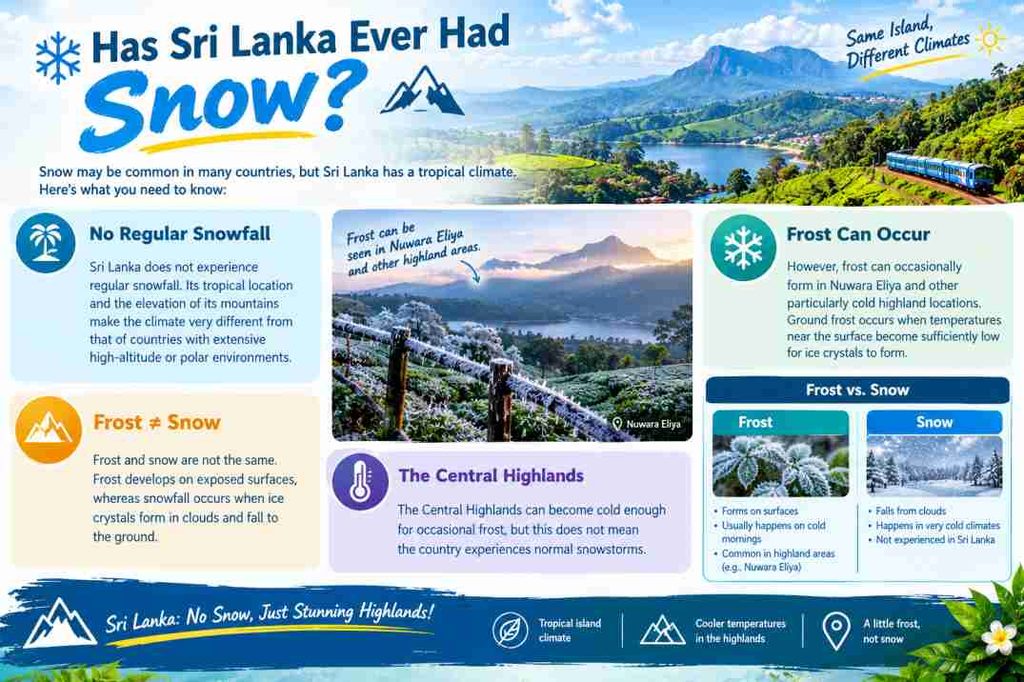
Sri Lanka does not experience regular snowfall. Its tropical location and the elevation of its mountains make the climate very different from that of countries with extensive high-altitude or polar environments.
However, frost can occasionally form in Nuwara Eliya and other particularly cold highland locations. Ground frost occurs when temperatures near the surface become sufficiently low for ice crystals to form.
Frost and snow are not the same. Frost develops on exposed surfaces, whereas snowfall occurs when ice crystals form in clouds and fall to the ground.
The Central Highlands can become cold enough for occasional frost, but this does not mean that the country experiences normal snowstorms.
12. How Hot Is Sri Lanka in Winter?
Sri Lanka remains warm during December, January and February, which are winter months in the Northern Hemisphere.
Lowland and coastal areas commonly experience daytime temperatures around 27–32°C, although actual temperatures vary by location and day. Humidity can make conditions feel warmer.
Colombo and other coastal towns generally remain warm, even when the country experiences its coolest seasonal weather.
The Central Highlands are an exception. Nuwara Eliya and surrounding elevated areas can experience much cooler temperatures, especially at night and before sunrise.
For this reason, visitors may experience warm beach weather and cool mountain conditions during the same trip.
13. What Is the Off-Season in Sri Lanka?
Sri Lanka does not have one nationwide off-season because different regions experience their wetter and drier periods at different times.
For western and southern coastal destinations, the southwest monsoon from May to September can bring rain and rougher sea conditions. Some travellers therefore prefer to visit these regions from December to April.
On the eastern coast, April to September is often a more favourable period for beach activities, while the northeast monsoon can bring wetter weather from around December to February.
October and November can be challenging for travellers who want consistently dry conditions because thunderstorms may affect much of the country.
The off-season can nevertheless be attractive for visitors interested in quieter destinations, green landscapes or flexible itineraries. Weather conditions, transport and accommodation availability should be considered when planning a trip.
14. When Should You Avoid Visiting Sri Lanka?
There is no period when every part of Sri Lanka should automatically be avoided. The more useful approach is to consider the weather in the particular regions you intend to visit.
If your main priority is spending time on the western and southern beaches, the southwest monsoon months may bring more rain and rougher seas than the December-to-April period.
For eastern coastal destinations, the seasonal pattern is different, and the middle months of the year are often more suitable for beach activities.
October and November can bring widespread thunderstorms, so travellers planning outdoor activities during this period should allow flexibility in their schedules.
Regardless of the month, follow official warnings when heavy rain, flooding, landslides, strong winds or dangerous sea conditions are expected. A seasonal travel guide cannot replace a current weather forecast.
15. Will There Be Monsoons in Sri Lanka in 2026?
Yes. Sri Lanka’s established climate pattern includes the southwest monsoon, northeast monsoon and two inter-monsoon periods during 2026, as in a typical year.
The southwest monsoon generally runs from May to September, while the northeast monsoon usually affects the island from December to February. The inter-monsoon periods fall around March–April and October–November.
These dates describe the usual seasonal pattern. The timing, strength and rainfall associated with individual weather systems can vary from year to year.
A seasonal outlook also cannot establish whether a particular district will receive heavy rain on a specific day. For that, residents and travellers should check the latest forecasts and warnings issued by the Department of Meteorology.
16. How to Check the Latest Sri Lanka Weather Forecast
Seasonal climate information helps explain what weather is typical for a region, but it cannot tell you exactly what will happen today or tomorrow.
For current conditions, check the latest forecasts from the Department of Meteorology and follow relevant official warnings. Pay particular attention to rainfall alerts, thunderstorm warnings, rough-sea advisories and landslide warnings when these are issued.
If you are planning a journey, check the weather for your destination rather than relying only on a national summary. Conditions in Colombo may differ from those in Nuwara Eliya, Batticaloa or Anuradhapura.
Weather.lk readers can use local forecasts and weather updates to understand changing conditions across the island. Always refer to the latest official warning when a potentially dangerous weather event is expected.
17. Is Sri Lanka Expensive to Visit?
Sri Lanka can suit a range of travel budgets. The overall cost depends on accommodation, transport, meals, activities and the destinations included in the itinerary.
Travellers who use public transport and eat at local restaurants may spend less than those choosing private drivers, luxury hotels and organised excursions.
Seasonality can also affect accommodation prices and availability. Popular coastal destinations may be busier during their more favourable weather periods, especially around holidays.
Weather can influence travel plans as well. Heavy rain may affect outdoor excursions or sea activities, while cooler highland conditions may require different clothing from a beach holiday.
Planning destinations around their seasonal weather can help travellers make better use of their time and budget.
Frequently Asked Questions About Weather in Sri Lanka
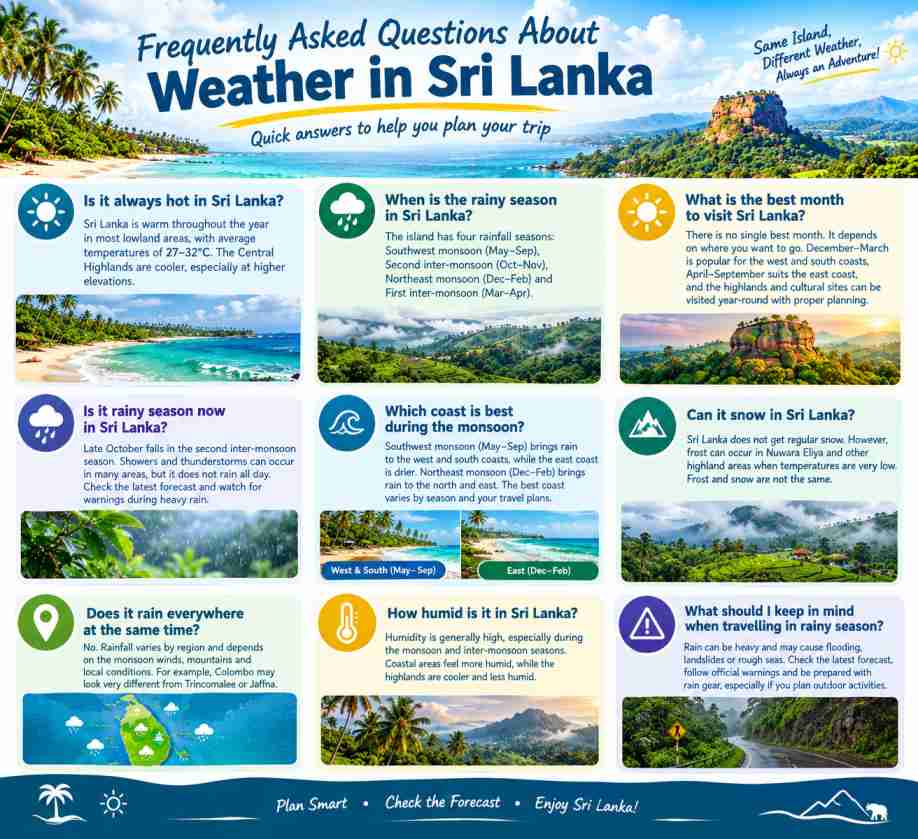
Is it rainy season now in Sri Lanka?
Late October is part of the second inter-monsoon season, which generally brings showers and thunderstorms to several parts of Sri Lanka. Daily conditions vary by location.
What is the best month to go to Sri Lanka?
December to March is generally suitable for visiting the western and southern coasts, while April to September is often favourable for the eastern coast. The best month depends on your destination and activities.
What is the coldest month in Sri Lanka?
January is generally among the coolest months, especially in the Central Highlands. Nuwara Eliya experiences much lower temperatures than the coastal lowlands.
When should you avoid visiting Sri Lanka?
No single month is unsuitable for the entire island. Choose your destination according to the monsoon seasons and check current weather warnings before travelling.
Why is it so rainy in Sri Lanka?
The two monsoons, inter-monsoon thunderstorms, low-pressure systems and the Central Highlands all influence rainfall. The amount of rain varies significantly between regions.
What is the off-season in Sri Lanka?
The off-season depends on the destination. May to September is generally wetter on the southwest coast, while October and November can bring widespread thunderstorms.
Which part of Sri Lanka is most beautiful?
The answer depends on personal interests. The Central Highlands offer mountains and tea plantations, the southern coast has beaches and coastal scenery, and the Cultural Triangle features ancient historical sites.
Is Sri Lanka expensive to visit?
Sri Lanka offers options for different budgets. Accommodation, transport, meals, activities and seasonal demand all influence the total cost.
Will there be monsoons in Sri Lanka in 2026?
Yes. The usual southwest and northeast monsoon seasons occur annually, alongside two inter-monsoon periods. Their actual strength and timing can vary.
Which is the coldest city in Sri Lanka?
Nuwara Eliya is widely known as one of the country’s coldest towns because of its high elevation and cool highland climate.
What is the coolest area in Sri Lanka?
Nuwara Eliya and the surrounding Central Highlands are among the coolest areas, with some high-elevation locations experiencing particularly cold early mornings.
Which city in Sri Lanka has the lowest temperature?
Nuwara Eliya regularly records some of the lowest temperatures among the country’s main towns, although the lowest reading on a particular day depends on local conditions.
Which country has the highest rainfall in the world?
Colombia is often listed among countries with the highest average annual rainfall. Rankings depend on the dataset and the period being measured.
Has Sri Lanka ever had snow?
Sri Lanka does not experience regular snowfall. Ground frost can occasionally occur in Nuwara Eliya and other cold highland locations.
How hot is Sri Lanka in winter?
Lowland areas commonly experience daytime temperatures around 27–32°C during December to February, while the Central Highlands remain considerably cooler.
What months should you avoid in Sri Lanka?
It depends on where you plan to go. May to September can be wetter on the western and southern coasts, while October and November can bring thunderstorms across many regions.
Where is the highest rainfall in Sri Lanka?
Some of the highest annual rainfall totals occur along the southwestern slopes of the Central Highlands, particularly in parts of the Kegalle and Nuwara Eliya districts.
Is it rainy season in Sri Lanka?
Sri Lanka has several rainy seasons rather than one island-wide wet period. October and November are generally part of the second inter-monsoon, while the southwest and northeast monsoons affect different regions at different times.
Final Thoughts
Sri Lanka’s weather changes with the seasons, the landscape and the direction of the prevailing winds. Understanding these differences makes it easier to plan travel, prepare for rain and recognise why one part of the country may be wet while another remains sunny.
For the most useful picture, combine general climate information with local forecasts. Whether you are visiting the beaches, exploring the Cultural Triangle or travelling through the Central Highlands, checking the weather for your destination is the best way to prepare for the conditions ahead.